
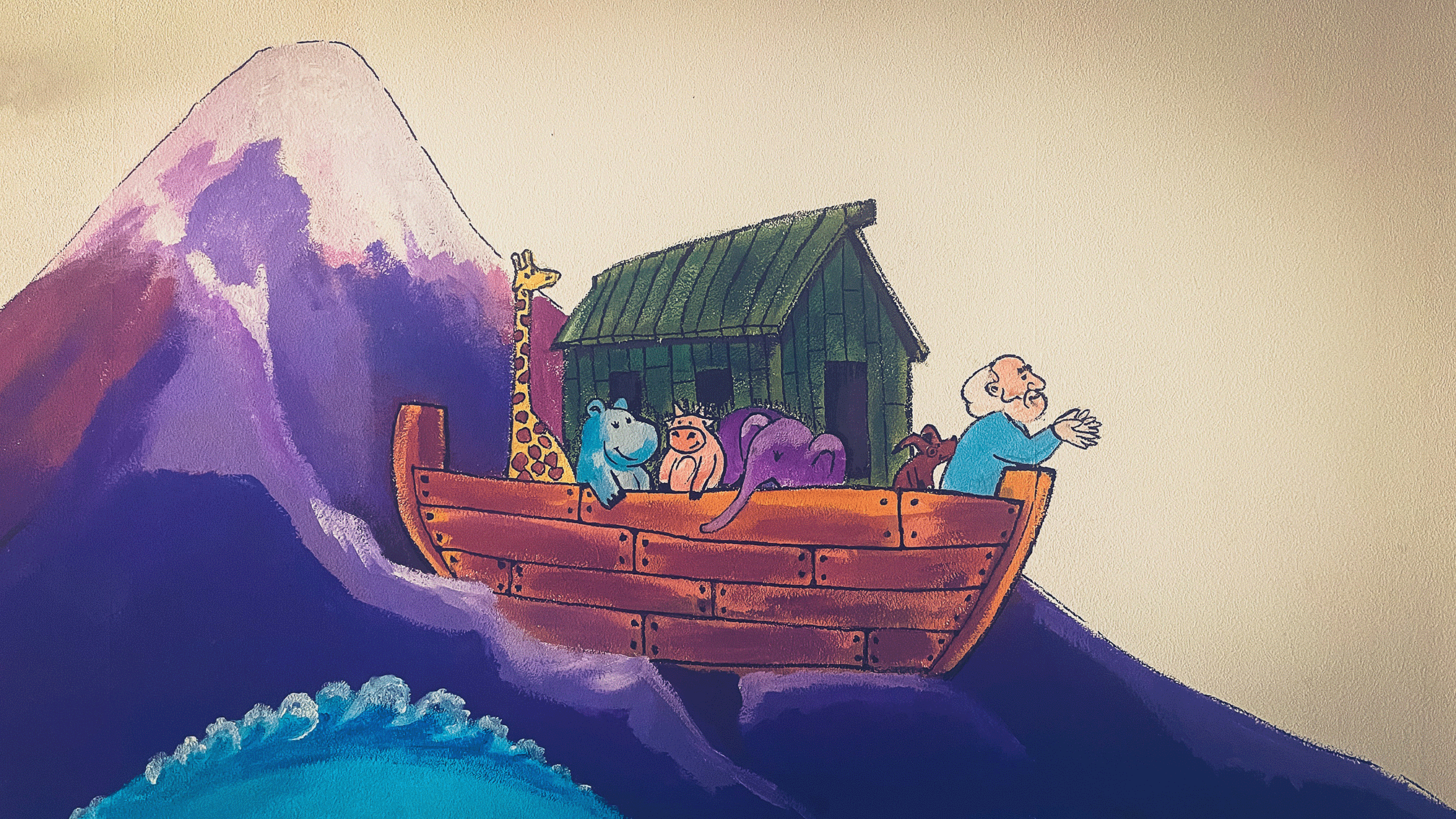
I know what you’re thinking— what on earth brought you there? An angsty family member, “God’s voice” in your ear? Instead, it was curiosity, but no, I didn’t go alone. My family wanted to make a trip to see it, and I decided to go with them out of interest in what Ken Ham had created for the Christian world.
I want to start this discussion with credits to the teams who worked to built this ark. It was very well built, with lots of attention to detail and cleanliness. The creative liberties they admitted to taking looked believable as a boat that would be built at that time. By no means am I an expert on history, though, and that may be what Ken Ham was looking to exploit with the exhibit.
Interestingly, this is not the only full-size Noah’s Ark interpretation. In the Netherlands, Johan’s Ark was built with a similar mission by Johan Huibers. It opened in 2012 to the public as a museum, and floats on the water. Ken Ham’s work opened in 2016 in Williamstown, Kentucky. It features three floors of exhibits, and surrounding areas with ziplines, playgrounds, and a zoo.
I will refer to each point discussed in the various exhibits as Ken Ham’s world view, as some differ greatly from how I was raised only a couple states over from where the Ark lies. There are two locations you can visit for different aspects of this, including the Ark Encounter and the Creation Museum. As I discuss points from both, I won’t expressly mention where they came from. Both museums are created for a similar purpose by the same foundation, and complement each other.
The Ark Encounter starts from the base of the boat, walking up a facade of scaffolding and large packages with food for Noah and his animals. It’s dark and appears to creak, giving the impression of the storm getting closer. You are then led through a series of rooms with exhibits mainly quoting Genesis through the flood story and relevant details. This museum is focused on telling the creation story and flood story from the Biblical perspective.
The Creation Museum is much more scientific. There are many exhibits showcasing the beliefs of Christians as Ken Ham tells us as compared to the atheist view (as if we all believed the same thing). There are also alternative science arguments, such as challenging the use of carbon dating. There is clearly a skew in some of the statements made to give some existential dread to the atheist view, but I found most of the atheists points to be relatively fair as compared to the moral claims he makes throughout both museums.
I also want to heavily criticize the politicization of the shops. When I walked in to the lobby known as the Answers Center, the books lined up included critiques on the social activist movement of pride and another book that was called “Transgender to Transformed”. In addition, there was a t-shirt that said “the true meaning of the rainbow- Genesis 9:13”. I find these extremely offensive and invalidating of personal experiences including some of my own. It took a lot of religious unlearning to be able to love and care for myself, and they made careless claims about people they do not even attempt to understand. This is judgement, and I find it very ironic considering they teach not to judge. That being said, I did not take the time to read the books, so I cannot comment too much. The fact that they are so readily available in the bookstore before entering the Ark is a bit alarming, though.
There are many claims made in the Encounter that I would like to discuss. These center around historical claims to the creation of the world, a historical flood event, causes of climate change, evolution, the flat earth conspiracy, and finally, my first experience in a sermon in a couple years. Let’s dive in.
The Creation
Ken Ham is famously a “young earther”. This means that he believes the earth was formed only 6000 years prior despite numerous scientific research claims that suggest a much older earth. The exhibit does not shy away from this— instead, it compares and contrasts the viewpoints, ultimately siding for Ken Ham’s point of view.
There is a graphic displaying information about the ice ages, or in their world view, the only ice age. It occurred as a result of the global flood about 4000 years ago. They contrast this to at least four major ice ages that we have discovered
One exhibit takes a shot at some Christians, saying that they try to reinterpret the Bible to fit the old earth position. They mention the gap theory, progressive creationism, the framework hypothesis, and the day-age theory. However, their rebuttal only says that they are “littered with problems”. In the Creation Museum, these arguments are brought up again and countered with conflicts in the Bible. These include that some or all of the arguments would suggest that the creation was not very good, that there would be conflicts in the order of events, the Genesis flood was not global, or that most creatures would have been gone before humans existed.
I still find these problematic because we are taking scientific arguments and countering them with verses from the Bible. I think that makes all of these discussions and debates so challenging because we have a hard time agreeing on how accurate the Bible is.
The Flood
Interestingly, they lean into the various flood myths from around the world. They display a large graphic of the globe and argue that the other myths embellished history. They also argue that many of the legends were written before Christian missionaries interacted with their culture, implying that they may be discussing the same event but mis-categorizing the size or origin. I did appreciate that the other myths were mentioned, because they share so much in common. However, I still consider the flood myths to be myths, including the Christian one. Whether it was an exaggeration of actual local floods, or stories carried down from generations, it does feel like a stretch to drown all land mass. Where did the water even come from?
“In approximately one year, the wicked pre-Flood world consisting of a supercontinent is destroyed and a new world with seven continents rises from the waters”
They argued that before the flood, the earth had a shape called Rodinia, followed by Pangaea during the flood, then by the end of the flood the earth took the shape as we see it in seven continents. I didn’t realize that there was a form of earth considered before Pangaea. In this argument, they are combining what scientists have learned and applied it to their young earth timeline. Scientists would say that there were only microscopic lifeforms during Rodinia, but the museum’s graphic would consider the garden of Eden to be on that form.
Climate Change
As for the global climate, Ken Ham believes we didn’t do anything to cause rising temperatures. An unsurprising Christian view, he claims that if centuries ago, we didn’t cause a rise in temperatures and it cooled off, then why would we be causing it now? They show a graph of year 1 AD until 2000, conveniently missing the current rises in temperatures in the last 20 years.
Evolution
I found it very interesting on how evolution was approached in the museums. Going in, I expected a full denial of evolution because God created everything individually. Instead, they argued that natural selection was real, but only affects pre-existing features and cannot create new ones. They also discuss mutations, and say that the majority cause negative effects. Further, even if they are “somehow beneficial”, they are not adding information necessary to transform animals into different species.
In the Creation Museum, there are many discussions on natural selection with genes changing such as the famous Darwin’s finches. They also talked about how bacteria can become resistant to antibiotics. I noticed that this became a theme, sprinkling in modern science with Biblical views, potentially giving people the impression that they have credibility.
They separated this concept of natural selection from evolution, considering evolution to be the creation of new genetic information. This is what they refuted. If genetic information can be created, that means that new species can be created from one to another.
I have a hard time agreeing with them for the simple fact that our biology is so similar to other species. If so much of our DNA is shared with a fruit, then wouldn’t the logic follow that we are somehow connected in the evolution of different forms of life?
Flat Earth
Interestingly, there are a number of texts displayed refuting the idea of a flat earth. They stated that the Bible hints at a round earth in multiple places, but didn’t cite where. I found this somewhat bizarre because this is not an idea that I would consider popularly accepted or believed. It was mentioned that in the late 19th century, the flat earth argument was popularized to belittle Christians by making the Medieval church look ignorant. It also simply states that there are some Bible verses that imply a round earth, though there are no actual citations once again.
The Sermon
I found myself sitting through a sermon and music. Below, I have quoted some notable statements that he made:
“‘For God’ in John 3:16 doesn’t prove the existence of God, it is proclaims it. So there is a God.”
This is avoiding the actual discussion of the existence of a god and the Christian God. Instead, he says that it is so because the Bible states it. However, without accepting criticism and doubt, there is no amount of plausibility that a religion can uphold for me.
“The world began by chance- ha”
Once again, he avoids the discussion of arguments and doubts that one may have about the beginning of the world by scoffing at anyone who dares to think different than him.
“God loves the homewreckers, God loves the homosexuals…”
Here, we are being compared with people who do things that harm others. Nobody is harmed by a gay couple existing, except for the ones who believe it is wrong and get their feelings hurt. It’s something I’ve noticed a lot, equating types of sin. A murderer or pedophile is no different than a gay couple who loves each other. Depending on your world view, you would read that sentence very differently.
All this being said, it was a pretty uneventful sermon. The man chosen to preach was a recovered drug addict “through Christ alone”. I don’t want to mock the struggles he has been through in that regard, although I do want to note that it felt like cherry picking someone who has been through something really challenging to give a sermon for more power in the speech.
Summary
Ken Ham’s thorough creations are a very literal take on the Bible. They use citations as fact, with little questioning of wording, translation differences, or other conflicts. However, the most powerful message in all of the work is this- you are nothing without God. He is “patiently delaying” your final judgement so that you have the chance to turn to Him. You deserve death as a sinner. Your only hope at a future without pain and suffering is by giving your life to Him. Nothing worldly is going to ever fulfill you. You cannot question God’s judgement either, because He created you, so He can do as He pleases.
If it isn’t clear, I don’t agree with that message. I grew up believing it, so it is not new to me. I have a hard time agreeing that there is so much evil in the world, and yet we must live a fulfilling life on earth as well. Since leaving the church, I have found ways to find fulfillment in what is important to me. In the things I do for others and the experiences I have with people I care about, I can find peace being honest and open with myself.
While feeling out of place at times, I did enjoy looking through the exhibits as an atheist. It gave me more clarity on my beliefs because everything I’d ever been taught was on the wall for me to scrutinize two years after leaving the church. I’d encourage others to do the same if you have doubts or questions, while keeping a very critical view, even as a Christian, on each statement made. It cannot simply be fact because it is stated on a poster. Many statements are made with messaging that is not giving other arguments a fair chance. That being said, consider where you are spending your money if you go, because it is not a cheap fare to enter.
I was not able to discuss everything that I saw in the museums, due to the massive amount of exhibits. If you would like to see more about the Ark Encounter, Bill Nye visited with Ken Ham and debated some of the issues discussed on the posters. Here’s the video:
Thank you for reading, and I hope this gives you some insight to Ken Ham and his work. Whatever you may believe, remember to stay critical and allow yourself to question before you take blind faith in someone else’s idea.
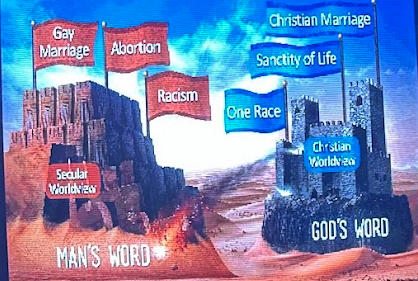
I’ll leave you with one image that was displayed in the creation museum that sums up what Ken Ham really thinks of non-Christian morals:
Stay safe, take care of yourselves, and you’ll be hearing from me soon.
G
Leave a Reply